[ 0, 2557 ]
In 1974, Ernő Rubik, a young lecturer at the Academy of Applied Arts in Budapest, wondered: how might a solid cube be cut into smaller pieces and reconstructed in such a way that each of its six faces could be rotated as a unit, without the whole thing falling apart. Being an architect, his concern was spatial: the relationship between an object, its parts and their movement in any direction.
Rubik did not realize that he had also created a very intricate puzzle, until he first scrambled the cube and tried to restore it – which took him more than a month. What he could not have anticipated was the combinatorial complexity of his invention, with a baffling 43,252,003,274,489,856,000 possible configurations! A number that escapes any human scale, derived from the mathematics of group theory: (8!·3⁸·12!·2¹²)/(2·3·2)
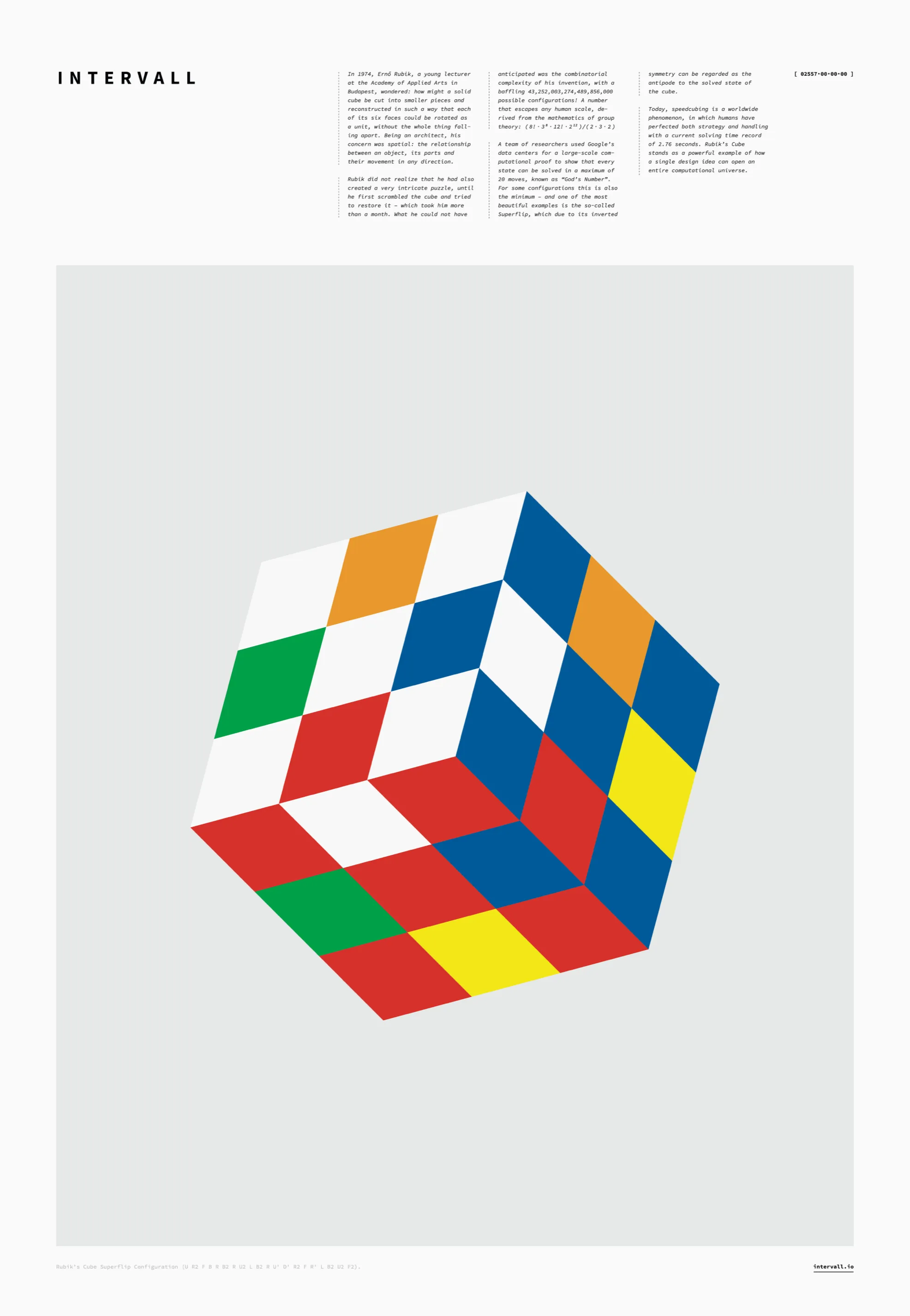
A team of researchers used Google’s data centers for a large-scale computational proof to show that every state can be solved in a maximum of 20 moves, known as “God’s Number”. For some configurations this is also the minimum – and one of the most beautiful examples is the so-called Superflip, which due to its inverted symmetry can be regarded as the antipode to the solved state of the cube.
Today, speedcubing is a worldwide phenomenon, in which humans have perfected both strategy and handling with a current solving time record of 2.76 seconds. Rubik’s Cube stands as a powerful example of how a single design idea can open an entire computational universe.